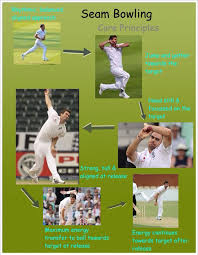
To bowl faster, focus on improving your technique through proper run-up, a braced front leg, and delayed arm action, and increase your physical fitness with strength training and conditioning. Key technical aspects include a smooth run-up to build momentum, planting your front leg straight and bracing it, and rotating your hips and shoulders in a way that delays your bowling arm for maximum whip-like effect. On the physical side, develop leg and core strength, improve your overall stamina, and work on explosive movements to convert your body’s energy into speed.
-
Run-up and momentum:
Start with a comfortable run-up and gradually increase your speed to build momentum. Aim to maintain this linear momentum as you transition into the bowling crease.
-
Front foot contact:
Land with your front foot straight and pointed towards the batter, creating a braced position that stops your lower body’s forward momentum and transfers energy to your upper body.
-
Shoulder-hip separation:
As your hips move forward, delay your shoulders and bowling arm. This creates a stretch in your torso, and the subsequent fast rotation helps generate a catapult effect.
-
Arm action:
Keep your bowling arm back for as long as possible to delay the release. Bring the arm over the head and follow through fully, ensuring a straight and firm wrist at release for control.
-
Trunk flexion:
Maintain a forward lean (flexion) in your trunk after front foot contact. Faster bowlers have greater trunk flexion as they convert run-up energy into rotational energy.


-
Strength and conditioning:
Strengthen your legs, core, and shoulders, as they are crucial for generating power. Exercises like squats, deadlifts, and core work are highly beneficial.
-
Explosive power:
Incorporate plyometric exercises like box jumps and explosive movements to improve your ability to transfer energy quickly from your lower to your upper body.
-
Stamina:
Engage in cardio exercises such as cycling or sprinting to build stamina, which is vital for maintaining pace throughout a spell.
-
Practice with weighted objects:
Use medicine balls or weighted balls to train your body to move through a heavier resistance, helping to translate that power to the lighter cricket ball.
-
Warm-up:
Always perform a proper warm-up and stretching routine before bowling to prepare your muscles and prevent injury.
-
Rest and recovery:
Allow your body adequate time for rest and recovery after training. Overtraining can lead to injury and hinder progress.
-
Grip:
Hold the ball correctly by placing your index and middle fingers on top, near the seam, with the thumb underneath. A firm grip provides control and can help with speed.
